

The Question
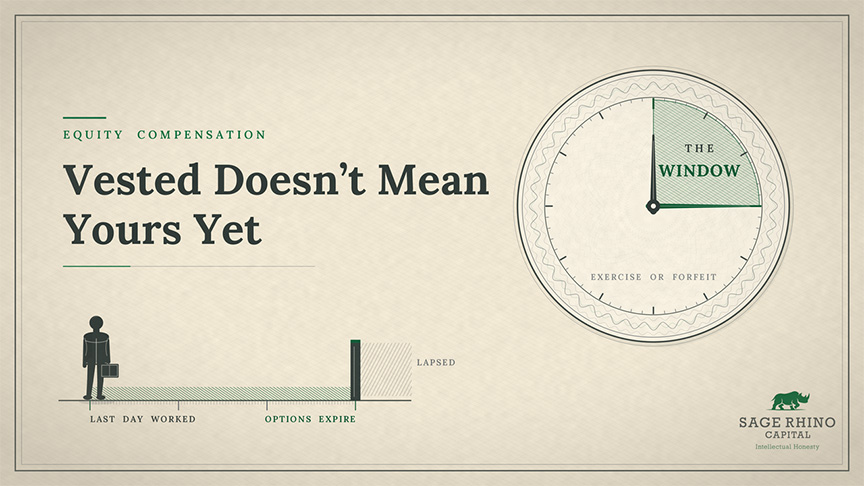
An employee leaves a private company holding vested stock options. Most assume there’s time to figure out what to do with them. There usually isn’t — the clock starts on the last day worked, not the day a decision gets made.
Three Angles
I. Exercise now, sort out the rest later. Locks in the position and starts any future tax clock earlier. The cost is upfront cash, out of pocket, for shares that may or may not ever be worth anything.
II. Let the window close. No cash at risk, no bet on an uncertain company. The cost is walking away from equity that may have taken years to earn — permanently, the day the window shuts.
III. Negotiate the window itself. Some companies will extend it, especially as part of a departure or severance conversation — a small but growing number now offer extensions of several years, even up to a decade. The cost: for incentive stock options, IRS rules convert them to non-qualified options the moment the standard 90-day window passes, even with an employer-approved extension — trading favorable ISO tax treatment for more time to decide.
The negotiation can run the other direction too — some new employers will offer a “buyout” or “make-whole” grant to offset equity being left behind, matching its value and vesting schedule. It’s rarely offered proactively; it typically has to be asked for.
What’s Being Said
U.S. employees left an estimated $33 billion in unexercised stock options on the table in 2021 alone, according to Pitchbook.
Don’t Procrastinate
The window is usually 90 days, sometimes less, and it doesn’t pause for a job search or a move. Whether to exercise, hold, or let it go is a real financial decision — but the deadline is fixed the moment the last day of work is. Waiting to decide is, itself, a decision.
One wrinkle worth naming: at a public company, this decision looks different. Vested options can typically be exercised and sold the same day — a “cashless exercise” — so there’s no need to come up with cash out of pocket the way there is at a private company. The 90-day clock and the tax treatment still apply the same way; what changes is that “exercise” and “sell” can happen in the same transaction instead of requiring a bet on an illiquid company.
The Reframe
“Your vested options have an expiration date the moment you leave — whether or not you’ve decided what to do about it.”