

The Question
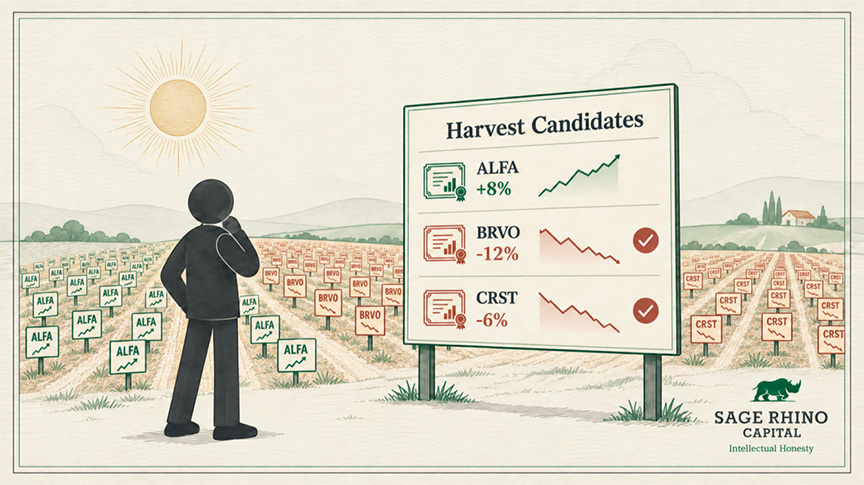
A client is looking at a position worth $100,000 that cost $125,000. The instinct is to wait for it to come back. The CPA’s instinct is to sell it. The real question isn’t whether a loss is a loss. It’s whether a loss on paper is worth turning into one on purpose.
That’s tax-loss harvesting: selling an investment in a taxable account for less than you paid, then using the loss to offset capital gains, plus up to $3,000 of ordinary income a year. Anything unused carries forward indefinitely. The proceeds go into something similar but not “substantially identical,” so the portfolio stays invested and the loss isn’t disallowed under the wash-sale rule (30 days before or after the sale).
Run the numbers on that $100,000 position, down 20% from $125,000. The $25,000 loss saves a top-bracket investor federal tax at whatever rate the offset gains would have been taxed. Against long-term gains, that’s 23.8% (20% plus the 3.8% net investment income tax), or $5,950. Against short-term gains, taxed at up to 40.8%, it’s $10,200.
Three Reasons To Take The Loss
I. Offset gains you’ve already taken.
A smaller tax bill this year. It only pays if there are gains to absorb; without them, the benefit shrinks to $3,000 of ordinary income a year, with the rest carried forward.
II. Bank losses ahead of a big gain.
Shelter for a future sale, such as stock from an IPO or shares from vested RSUs. (Vesting itself is ordinary income; the capital gain comes when the shares are sold.) The bet is that the gain actually arrives.
III. Swap the loser for something better positioned.
A position that fell 20% has no memory of what you paid and owes you nothing. The proceeds can go into a diversified holding instead of a single stock’s comeback, the logic of Modern Portfolio Theory: the market pays you for the risk you take, not for the price you paid.
What’s Being Said
Vanguard’s 2024 research found that harvesting added a median 0.47% to 1.27% a year to taxable stock holdings under ideal conditions (daily screening, individual stocks, every tax dollar saved reinvested). Under less disciplined conditions the figure fell to roughly 0.04% to 0.13%. An MIT-led study of U.S. large-cap data back to 1926 found about 1.10% a year, falling to 0.85% once the wash-sale rule was applied. The diversification logic behind the third reason traces to Harry Markowitz’s 1952 paper “Portfolio Selection” in the Journal of Finance.
Three Dials
I. The replacement has to keep pace.
The replacement can’t be identical to what was sold, or the loss is disallowed. That means some difference in returns is built in. If the replacement tracks the original closely, the tax savings stay in the investor’s pocket and can be reinvested. If it lags, that shortfall can outweigh the tax saved. If it outperforms, the investor gains twice. The strategy only needs the replacement to be a good substitute, not a perfect one.
II. Timing the loss against the eventual sale.
Harvesting a loss lowers the cost basis of what replaces it, so the tax isn’t forgiven, it’s deferred. The bill comes due when the replacement is eventually sold. How much the harvest was worth depends on how long the deferral lasts and what rate applies when it ends. A long hold, a lower future rate, or shares that are gifted or passed on can make the deferral close to permanent. Selling soon, or into a higher rate, hands most of the benefit back.
III. Whether the loss was short-term or long-term.
The loss offsets gains of its own kind first. A short-term loss offsets short-term gains, which are taxed at the highest rates. If the replacement is then held past a year, its eventual gain is taxed at the lower long-term rate, so part of the benefit is a rate difference, not just deferral. A long-term loss offsets long-term gains, where the rate gap is smaller and the benefit is mostly deferral. Either way, the loss only pays now if there are gains of some kind to absorb it.
None of these is a flaw in the strategy. They’re the dials that determine how much it’s worth.
Ask Yourself
Do I have capital gains I need to offset? Would I sell this position if tax weren’t part of the decision, or am I letting the tax tail wag the portfolio?
The Reframe
“Finding a loss is easy. Deciding it’s worth taking is the strategy.”
Sources
Vanguard Research, “Tax-loss harvesting: Why a personalized approach is important” (July 2024)
Chaudhuri, Burnham & Lo, “An Empirical Evaluation of Tax-Loss-Harvesting Alpha,” Financial Analysts Journal (2020)
Harry Markowitz, “Portfolio Selection,” Journal of Finance (1952)
IRS Topic No. 409 and Topic No. 559
Kiplinger, “The IRS Capital Loss Carryover Rule” and “Capital Gains Tax Rates 2025 and 2026.”