

The Question
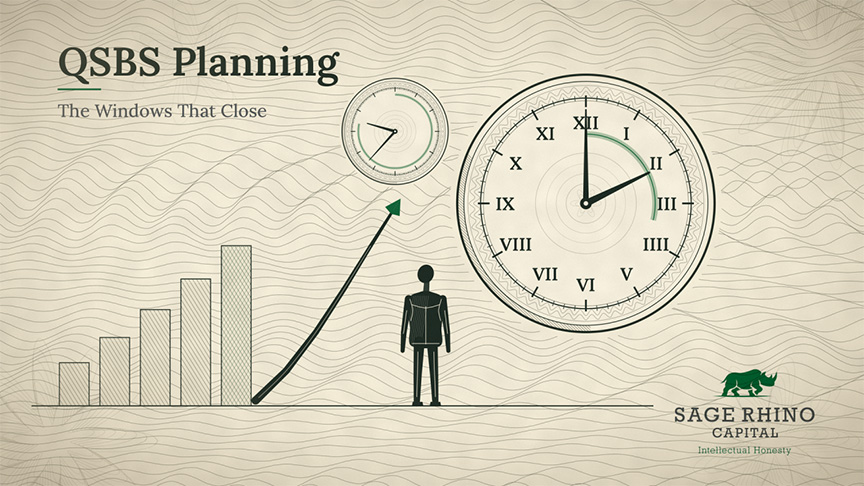
In a world where the average senior engineer is leaving the incumbent to start their own company, QSBS planning is more relevant — and running on a more compressed timetable — than ever before.
A founder or early employee holds stock that might qualify for a full exclusion on the gain when it’s sold — or might not. The real question isn’t do I have QSBS – it’s how would I even know, and by the time I find out, is it too late to matter.
Three Angles
I. Assume it qualifies. Optimizes for not leaving the benefit on the table. The cost: an expensive tax return if the assumption is wrong.
II. Assume it doesn’t. A conservative, no-surprises plan. The cost: potentially walking away from an exclusion worth millions, simply by never checking.
III. Confirm it early, in writing. Certainty years before a sale, while there’s still time to plan. The cost: it takes someone actually doing the work well before anyone’s thinking about an exit — a cost that lands harder on a shorter runway. A five-year hold is easy to lose track of over a decade at one company; it’s much easier to run out of room on when the company itself only exists for three or four years before the next one starts.
What’s Being Said
Tax litigation firm Holtz, Slavett, Drabkin & Warner reports that the IRS is actively auditing and challenging Section 1202 claims as the exclusion has grown more valuable, with improper documentation among the flagged issues, and QSBS tax attorneys at Kugelman Law identify the gross-asset test — whether the company was actually still small enough the day the stock was issued — as one of the most frequently litigated and audited issues in a QSBS claim. In one recent federal case, a taxpayer’s exclusion was rejected in part because he couldn’t prove exactly when his holding period began; the court held that the burden of proving the timing falls on the taxpayer, not the IRS.
Where to Start
Not with the sale — with the issuance date. Recent law changed what that date determines. Stock issued on or before July 4, 2025 falls under the legacy rules: a gain exclusion of the greater of $10 million or 10x basis, a $50 million company gross-asset limit, and a strict five-year hold before any of the exclusion is available. Stock issued after July 4, 2025 falls under a new framework: a higher cap — the greater of $15 million or 10x basis (indexed for inflation starting in 2027), a $75 million gross-asset limit — and a tiered holding period that phases the exclusion in early: 50% at three years, 75% at four, 100% at five.
The starting point is simply asking: when was this actually issued, and has anyone confirmed the company qualified at that time — under whichever framework applies? For someone moving between companies faster than they used to, that question is worth asking sooner rather than later — the five-year clock doesn’t extend itself just because the timeline got tighter.exercise” and “sell” can happen in the same transaction instead of requiring a bet on an illiquid company.
The Reframe
“The exclusion isn’t decided by the company you joined. It’s decided by the day your shares were issued.”
Sources used:
IRC Section 1202, as amended by the One Big Beautiful Bill Act, Public Law 119-21 (signed July 4, 2025; full text via govinfo.gov); Holtz, Slavett, Drabkin & Warner, APLC, “IRS Cracking Down on Section 1202 Qualified Small Business Stock (QSBS) Claims” (hsdwtaxlaw.com), on increased IRS audit activity; Kugelman Law, “Qualified Small Business Stock (QSBS): The Complete Guide to Section 1202” (kugelmanlaw.com), on the gross-asset test as a frequently litigated issue; Ju v. United States, U.S. Court of Federal Claims, on the taxpayer’s burden of proving gross-asset and holding-period timing at issuance.