

Markets
Despite a jittery December, 2024 was another year for the record books.
Building on the momentum of an exceptionally strong 2023, this past year delivered broad gains for equities but especially so for large cap US stocks. The S&P 500 rose 25.02% in 2024, with the S&P 400 MidCap and the S&P 600 SmallCap coming in at 13.93% and 8.70%, respectively1. In short, it was another robust year in which US equities set 57-all time closing highs along the way!
International performance was less impressive, with the S&P Developed Ex-U.S. up 3.67% and the S&P Emerging up 12.3% for the full year1.
Fixed Income markets delivered mixed performances with the US Agg coming in at 1.9% for the year1, having been negatively impacted by the sharp rise in the yields in the fourth quarter.
Broadly speaking, we are cautious on equity markets, particularly large cap US stocks. The short to intermediate part of the yield curve looks reasonably compelling at this juncture.
Your performance net of fees is posted to your Sage Rhino client portal.
International Stocks
Foreign equities have struggled to keep up with domestic stocks in the recent past. The gap has been substantial with international stocks lagging US stocks by over 5 percentage points annually for the last 10 years! Understandably, many feel like giving up on the asset class and doubling down on what has worked well lately.
That’s not our advice.
Allowing recent performance to influence one’s decision making – and 10 years is a very short period as far as markets are concerned – is a common, well-known and deleterious psychological predisposition. Also known as a “recency bias”- it is a cunning enemy of investors from time immemorial.
Longer term perspective is needed here. Over the long run, the performance of US vs international stocks has been comparable and there were certainly extended periods when domestic stocks were left in the dust. Consider the decade of 2002 to 2011. For that period, international stocks had trounced US equities by over 2.5% per year for 10 years straight!
We are now deep into a period of significant diversion between US and foreign stocks as shown below:
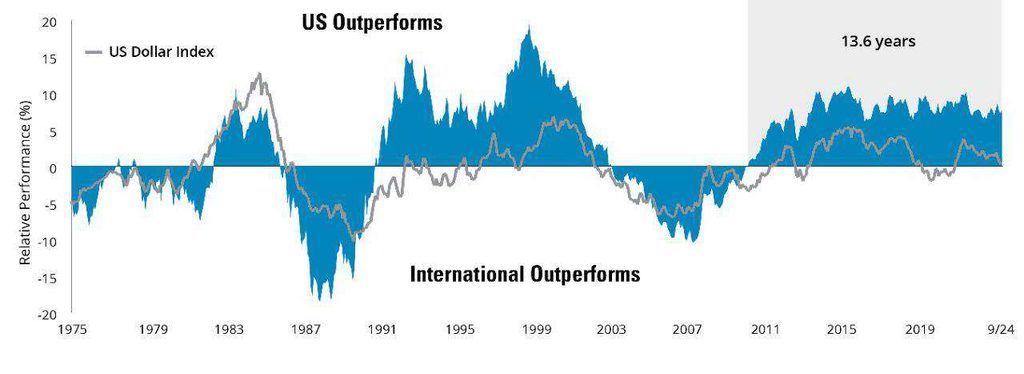
As a result, the valuation gap between domestic and international stocks is now extreme and we believe international stocks present a compelling opportunity and have a place in most healthy, broadly diversified portfolios.
Fading (Generational) Wealth
We like to think that wealth lasts forever, that fortunes built during times of opportunity – like now – will sustain themselves through generations. It’s comforting to imagine that financial security for you and your descendants becomes inevitable with enough money. But history tells a different story.
Earlier this month, a notable and provocative research paper landed on our desk, and we thought to
share with you some important findings here
In The Gilded Age and Beyond: The Persistence of Elite Wealth in American History2, Priti Kalsi and Zachary Ward take us back to the late 19th and early 20th centuries, a time when fortunes were built and lost with breathtaking speed. Using millions of records from the U.S. Census, they paint a clear picture: wealth doesn’t stay put. In fact, the higher you climb, the harder it is to hold on.
Here’s the eyeopener: 72% of people in the top 1% of wealth (or about $14 million today) lost that status within just ten years. For those at the absolute peak—the top 0.1%—85% fell out of their rarified group in the same span. That’s a churn rate that rivals today’s startup failure rates. It’s easy to forget that even the titans of the Gilded Age, people like the Rockefellers and Vanderbilts, faced pressures that could erode their wealth over time.
This turnover wasn’t a fluke. It happened consistently, across decades and regions. The data shows that elite wealth isn’t a fortress—it’s a tide. And tides recede.
The grandkids are not alright either. Generational wealth feels like it should last forever. But here’s the truth: 93% of grandchildren of the top 1% in wealth didn’t maintain that status. Even when both sets of grandparents were extraordinarily wealthy, 87% of their descendants fell out of the top 1%. Why? Partly because wealth gets diluted – split across family members, spent on consumption, or donated to causes. But it’s also because the traits that build wealth – entrepreneurial drive, bold risktaking, sometimes just dumb luck – don’t always pass down through bloodlines.
This story isn’t just about the Gilded Age. It’s about understanding how fragile wealth can be. You might climb to the top, but staying there is harder than anyone likes to admit. Families that built fortunes didn’t just face challenges from market crashes or wars—they had to contend with time itself.
Staying rich is a lot harder than it seems, and you need all the help you can get. A healthy relationship with a good financial advisor can be invaluable in navigating vicissitudes of both markets and time.
Thank you for your continued support
1 “Index Dashboard: U.S.,” S&P Dow Jones Indices, December 31, 2024
Sage Rhino Capital, LLC is a Registered Investment Adviser. This report is solely for informational purposes. Advisory services are only offered to clients or prospective clients where Sage Rhino Capital, LLC and its representatives are properly licensed or exempt from licensure. Past performance is no guarantee of future returns. Investing involves risk and possible loss of principal capital. No advice may be rendered by Sage Rhino Capital, LLC unless a client service agreement is in place. Account statement from the custodian is the official record of holdings, balances and security values. Sage Rhino Capital does not provide tax advice.